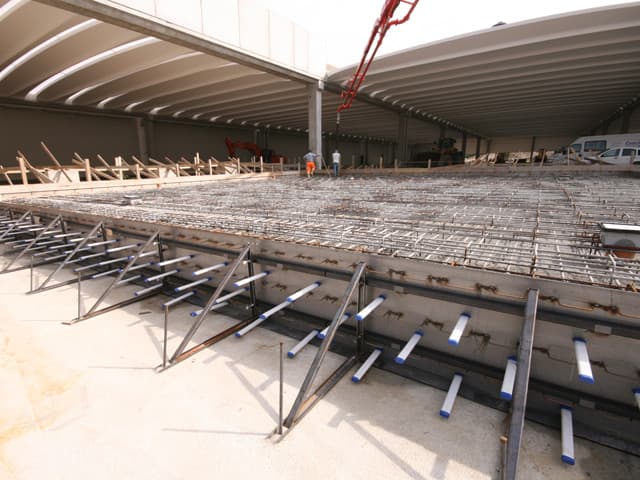


IDEAL WORK IDEAL JOINT SYSTEM® Flooring joint
IDEAL JOINT SYSTEM® are continuity solutions within concrete floors, separating portions of the floor made at different times. IDEAL WORK has developed a series of pre-formed construction joints that satisfies and solves all the needs and problems that may arise for the floor designer. Not just one "good-for-every-occasion" joint, therefore, but three types of joint, each one different because it is designed to solve specific problems, but all characterised by high reliability, extreme ease of installation and bi-directional operation.
What are construction joints
Construction joints are continuity solutions within concrete floors, separating portions of the floor constructed at different times. Construction joints are not simply 'casting joints'; operators know how much maintenance these elements require, considered worldwide to be the Achilles' heel of all concrete slabs (roads, bridges, airports, forecourts and industrial floors). Two adjacent slabs, in fact, although deforming in different ways, must allow the transfer of bending stresses triggered by operating loads, in order to limit the degradation of the edges caused by micro-shocks due to load cycles and transitions. In essence, the joint must allow for the free transfer of horizontal relative translations in the direction orthogonal to the joint plane, which are generally caused by thermal expansion or contraction due to hygrometric shrinkage of the floor, but must also prevent relative translations in the vertical direction and relative rotations between the two floor portions.
Themethods for making a construction joint
The system most commonly used to date for making construction joints was the one that goes by the name of "rod joint" or "barrotti". It consists of inserting, between two paving slabs cast at different times, a series of horizontal metal bars parallel to each other and orthogonal to the plane of the joint, whose task is to transfer stresses and prevent relative movements that are not permitted. The correct construction of a connecting rod joint involves the execution of a series of operations which, although not very complex, require a certain amount of attention. Often due to lack of care or time, or even because the construction of joints is not always adequately remunerated, mistakes are made that can lead to serious defects in the floor. The first operation, which is usually not carried out correctly, concerns the construction of a full thickness containment formwork, which is replaced by a partial formwork, which, rather than being a concrete containment element, acts as a reference level for casting dimensions. In practice, it is most often preferred to place the bars against a dry concrete curb and to place a partial formwork consisting of a wooden board above them.
The position of the electro-welded mesh
A further mistake, which is often made, is to arrange the wire mesh so that it passes through the construction joint. In this way, the mesh opposes translatory movements, which should instead be allowed by the joint, causing further injuries. It is also known that the mesh should be placed at 1/3 of the thickness of the floor, measured from the upper edge of the floor, in order to perform its task correctly.
The IDEALWORK construction joint: "the joint that slides"
IDEAL WORK presents to designers and floor builders its own patented prefabricated steel joint system: IDEAL JOINT SYSTEM® , specially developed and designed to offer designers a modern and scientific system for resuming the transfer of loads between concrete slabs, and builders a simple and inexpensive installation. IDEAL WORK's research to develop a system that would give sufficient guarantees to the designer and be easy to apply for the builder, began with the findings on damaged floors and the study of experiences gained in other countries at the forefront of concrete floor design and construction. The solution identified, called IDEAL JOINT SYSTEM®, facilitates the movements of the concrete plate, transversal and parallel to the joint, allowing the plate to shrink in both directions and reducing the number and width of cracks.
To summarise, the essential characteristics of the system are:
- The ability to resume movements in both directions, not opposing shrinkage contractions;
- The ability to resume differentiated vertical movements between two adjacent plates;
- The use of the steel profile to support the footprint of the trolley wheels as they pass and to keep the distance between the two plates protected.
How it works
IDEAL JOINT SYSTEM® makes extremely simple something that is actually very complicated. The trolley system does not allow the two plates to move in a 'bi-directional' manner and this causes major problems in both design and construction. The PVC connector is the key to the IDEAL WORK system. It acts as an assembly for the two bars, as a joint for the ovoid sleeve, and as a coupling and guide for the metal bar. Once the concrete has hardened, when stresses begin to build up from the concrete, the PVC fitting breaks, leaving the joint free to 'open'. The movement is completed when, as a result of lateral movement, the plastic strips inside the PVC sleeve give way and leave space for the barb to move horizontally.
Why PVC
For a perfect match between design and finished work, it is necessary to eliminate all possible installation risks. The easier the installation, the less the risk of errors and forgetfulness. The decision to use PVC for all assembly parts is dictated precisely by this need: many handmade joints produced directly by installers or mechanical workshops not only do not work correctly (see table comparing with other methods), but in many cases, due to design errors or forgetfulness on the part of the installers, can cause serious damage. In the case of metal assemblies, if the fitter forgets one or all of the screws, the joint does not work and cracks are created. In other cases, handcrafted joints are not properly designed and manufactured; for example, bars are fixed to the joint by welding. The lack of squareness of the bars can cause problems. PVC eliminates all these problems and the installer does not have to worry about removing screws, loosening sleeves or eliminating other locking systems. The designer in turn does not have to worry about checking the work of the installers.
Theelectrowelded mesh
Regarding the problem of positioning the electrowelded mesh, typical of classic joints, IDEAL JOINT SYSTEM® is sized so that if the electrowelded mesh is laid over the anchoring brackets (see figure 18), it will be exactly on the top 1/3 of the casting, as prescribed by the literature on concrete floors.
Fields of application
IDEAL JOINT SYSTEM® is particularly suitable for floors subject to forklift and pallet truck traffic. In particular, the wheels of the latter are highly destructive if the joint is not properly designed and manufactured. Main fields of application:
- Industrial flooring
- Heavy industry
- Logistics
- Trade fair halls
- Distribution centres
- Shopping centres and hypermarkets
- Airports
- Outdoor forecourts
- Docks
Heated interior floors
IDEAL JOINT SYSTEM® can also be used to properly create joints between two portions of radiant heated floors ("underfloor" heating).
External floorings
External floorings have different requirements from internal ones, as they are subject to large temperature fluctuations and weather conditions (water, snow, ice). In particular, the thermal delta creates expansion which, if not properly absorbed by the construction joints, can damage the floor. Two portions of the floor can, in fact, compress and rub against each other, creating "cracks".
IDEAL JOINT SYSTEM® offers designers the possibility of foreseeing and therefore absorbing expansion by inserting two strips of expanded polyethylene, of varying thickness, between the two "shoulders" of the joint. It is also possible to request galvanisation of the metal parts (excluding the bars), for better protection from external agents.
Further info from manufacturer on IDEAL JOINT SYSTEM® IDEAL WORK
0
0