Напольные покрытияUnical#Unical#Unical Drain#Outdoor flooring#Street furniture and outdoor#Sports flooring
UNICAL DRAIN BIKE
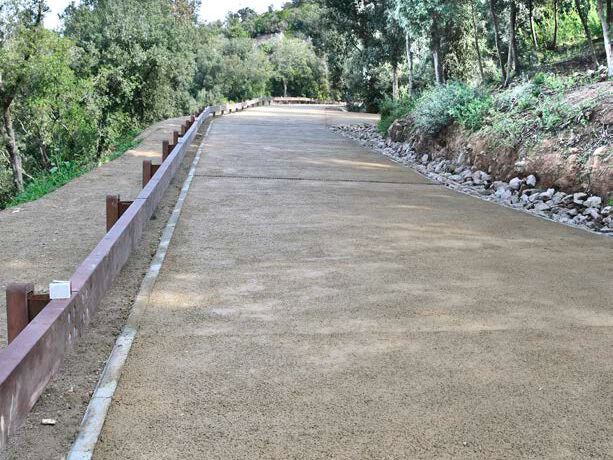
UNICAL DRAIN BIKE has been formulated for the construction of bicycle and pedestrian paths, especially in a rural or rural context where the subgrade soil is subject to deformation over time and variability along the route. In these applications, rather than the load to which they are subjected, drainage pavements must resist deformations imposed by the subgrade, which must in any case be correctly designed and executed.
Performance references
In this concrete, hydraulic parameters such as porosity and permeability are adequate for the application.
A minimum of 150 mm has been assumed on ballast with a minimum thickness of 200 mm depending on the type of subgrade.
The choice of fine aggregate ensures sufficiently comfortable transit for bicycles, wheelchairs, scooters.
The UNICAL DRAIN BIKE formulation is suitable for all types of paving: with a vibratory paver, with rollers, with a straight-edge and mechanical trowel.
The maintenance of workability is on average sufficient for all types of product application.
The Unical Drainage Concrete DRAIN
Although not one of the newest construction technologies, drainage concrete is experiencing renewed interest, especially among administrations, which are increasingly committed to sustainable stormwater management. The high water flow rate, which can drain through the porous matrix of the material, allows rainfall to be captured and percolate into the ground. This results in a number of benefits. The most significant of these are the recharge of the water table, improvements in the quality level of the water returned to the water body, and a reduction in the runoff of rainwater from impermeable surfaces in metropolitan areas into watercourses during increasingly intense rainfall events.
The drainage pavement and ballast can act as a useful lamination reservoir to compensate for the considerable difference in permeability between the pavement and the underlying soil.
Their porosity therefore allows water from the most intense meteorological events to be stored and then reintegrated.
All these hydraulic advantages are obtained against a floor bearing capacity that cannot be found in any other similar solution, such as, for example, draining ballast.
However, to achieve these results, it is necessary that the construction details are carefully carried out at the construction site and the laying methods adhere to the design specifications.
Advantages of drainage pavements
Appropriate design of Unical DRAIN drainage concretes gives them the following characteristics.
Permeability: is the volumetric flow rate of water that passes through the surface unit of a draining concrete slab in the unit of time: it is an index of its ability to allow the infiltration of water from intense meteorological events.
Load-bearing capacity: this is the capacity of the floor system to bear the loads on it which, in turn, is a function of the substrate, thickness and flexural strength of the draining concrete slab.
Porosity: represents the amount of voids within the drainage concrete floor slab: it is an indication of its ability to act as a storage layer.
Pollutant removal: drainage pavement systems have a considerable capacity to remove pollutants that rainwater intercepts on the surfaces over which it drains.
Mitigation of the urban heat island: drainage concrete improves thermo-hygrometric conditions, decreasing the heat island effect typical of densely populated urban areas.
Colouring: drainage concrete can be pigmented throughout the entire thickness of the pavement by colouring the paste that surrounds the aggregates. This feature gives the product a uniform colour.
Architectural finish: with a particular workmanship on site, it is possible to obtain a surface in keeping with a rural context given the changing colouring of the aggregates on sight.
Photoluminiscent finish: it is possible to achieve an attractive photoluminiscent finish thanks to the use of materials capable of emitting light at night after having absorbed light energy during the day.
0
0