Управление строительствомHSH#HSH#Straus7#Software#Structural calculations#Masonry and mixed construction calculations
HSH
Straus7 's non-linear solver module allows the application of the following three types of non-linearity to all elements in the library:
Geometric non-linearity.
Non-linearity by material.
Non-linearity due to boundary conditions (contact problems).
Different "Debug" techniques are available to the user for checking the convergence of non-linear solutions.
Through the flexible implementation of links (costraints), non-linear 'restart' procedures can be used for the simulation of even complex construction sequences.
Straus7 has explicit step solvers with solving algorithms à la Wilson or Newmark.
Non-linearity is completely generic considering geometric effects, non-linear material and/or contact conditions. If contact elements are present, automatic algorithms allow the time step to be reduced under proximity conditions. Thermo-mechanical coupling analyses in the transient are also possible.
Straus7 includes elements dedicated to the simulation of non-linear insulators and dissipators even with non-linear viscosity (tabular definition of force-velocity relations).
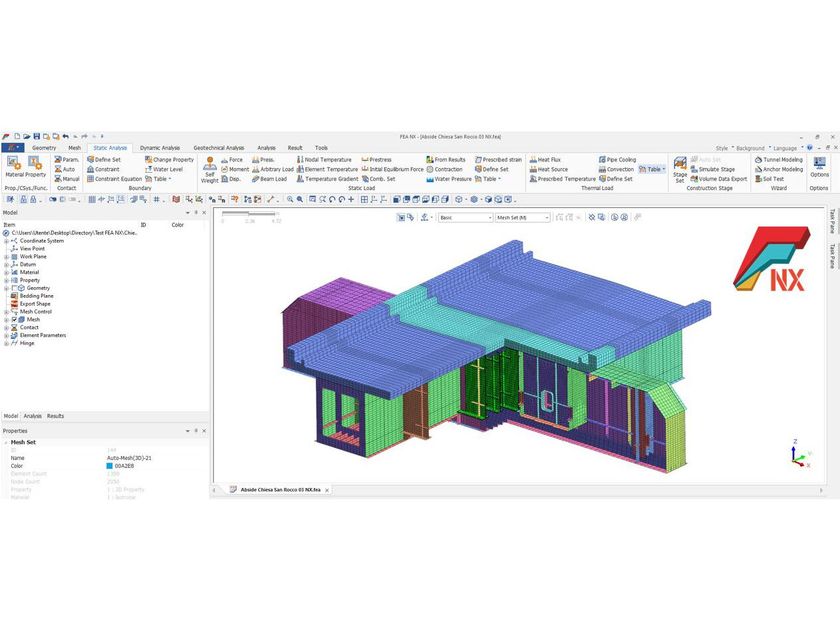
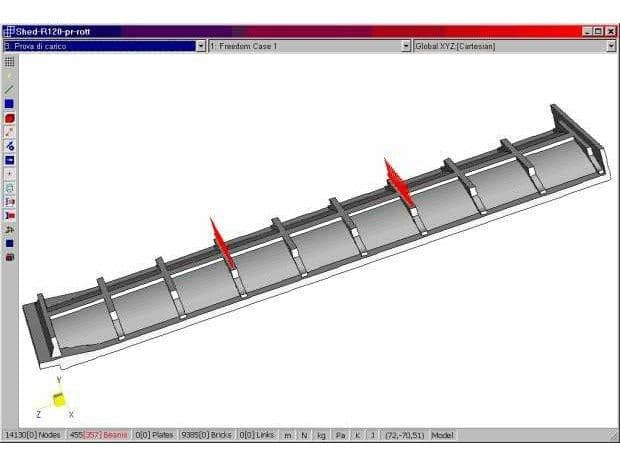
Straus7 is the software for linear and non-linear analyses of structures in the static and dynamic domains. It has a fully integrated model pre- and post-processing environment and a wide range of solvers for different analyses.
All modules that make up the calculation system have been implemented by a single team of developers and coherently integrated within a powerful, yet easy-to-use graphical interface.
Straus7 is a calculation and design software for finite element engineering, used worldwide by leading design offices, construction companies, public authorities and universities. It is known for its ease of use, its complete integration into Windows and its flexibility through the availability of stand-alone or network licences. The software offers a range of pre-processing functions for direct insertion of finite element models, including copy, extrusion, scale, displacement and reflection, as well as easy insertion of nodes and elements. The software also allows the processing of rod systems imported from DXF format and the alignment of local axes in one-dimensional elements. In addition, the software provides the option of automatically assigning nodal offsets according to the type of section used and automatically generating rigid planes or rigid clusters.
Straus7 offers the possibility of working on multiple models simultaneously, with the ability to exchange data between models using cut-and-paste tools and solve multiple models together. The software also offers unlimited undo and redo capabilities, allowing all changes made to a model to be undone without concern for model complexity or the number of affected entities.
The software produces high-quality two-dimensional meshes with a predominance of square elements automatically, and provides users with tools for checking the correct implementation of finite element models. Nodal discontinuities within the model can be detected by graphical representation, histograms of the quantities defining the quality of the model can be displayed, and applied loads can be shown graphically.
Straus7 is highly customisable, offering many options for graphical representation, colour definition, light source and perspective. Furthermore, file allocation can be configured, improving network work by sharing specific files on a dedicated drive and leaving temporary files on a different machine, such as a faster PC.
Finally, the Rondo application allows BIM coupling between Straus7 and BIM software for steel structures, offering BIM Coupling functionality. Rondo allows the export of structural steel elements and their connections from the FEM model to the BIM, reducing errors in the BIM modelling of connections through the use of special control tools. Furthermore, Rondò automatically groups the different connection types in the structure, thus simplifying the management of the BIM model.
0
0