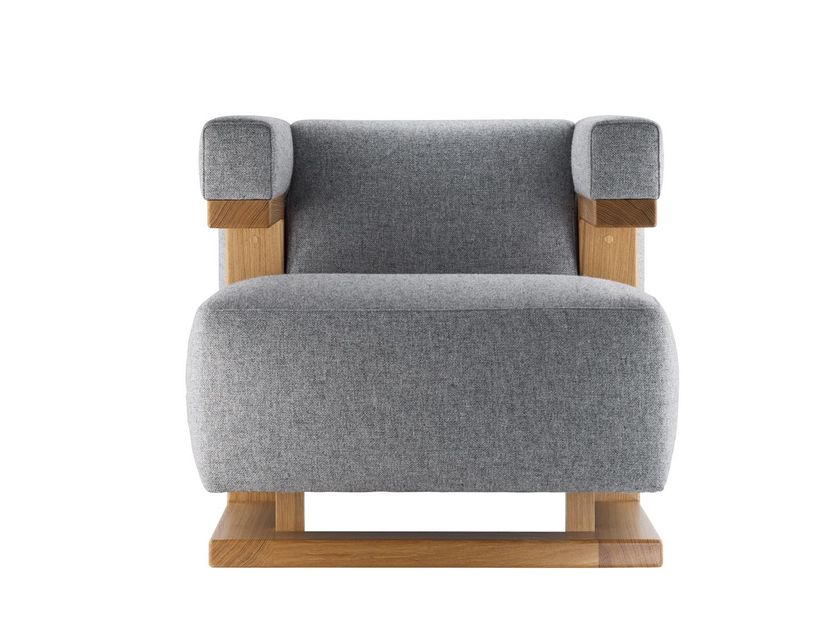
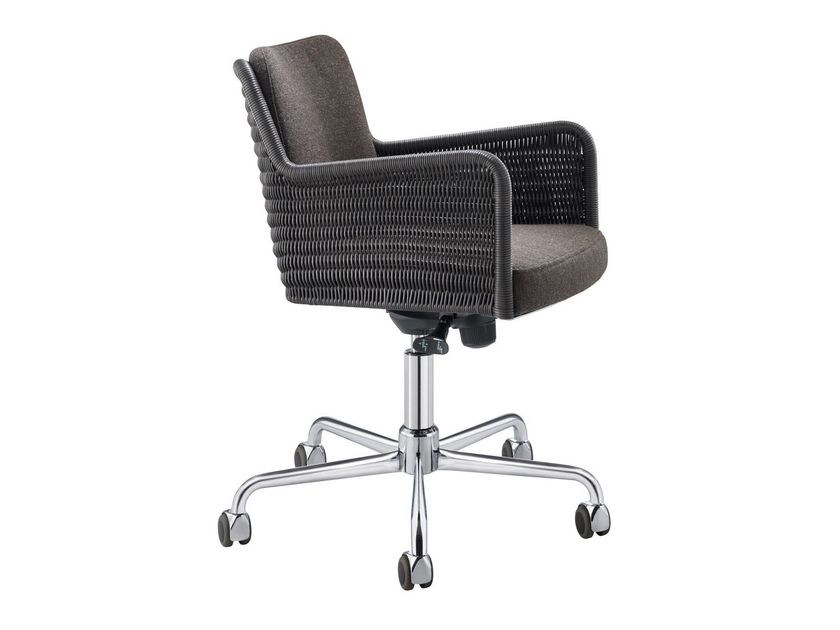
TECTA D42 Cantilever chair with armrests
1926 saw the launch of the architectural collective “Der Ring” with members including Walter Gropius and Mies van der Rohe. That same year, Mies van der Rohe designed the most beautiful chair of the century with a single brushstroke: the Weißenhof Chair. A year later, in 1927, it was displayed at the Weißenhof exhibition in Stuttgart. In 1985 Stefan Wewerka described it as “the most beautiful ‘chair construction’ since the throne of Charlemagne.” The first sketches were influenced by the gas tube chair without hind legs created by the architect Mart Stam.
In 1985 Tecta’s Axel Bruchhäuser analysed Lilly Reich’s creative approach with the help of Sergius Ruegenberg. For him the contrast between the cool steel and warm natural cane was particularly visible at the transition point, marked by a small bulge where the cane wickerwork ends and the steel continues.
This is one of the indications that this is an original. Another special feature that can only be found at Tecta today is the double lenticular natural canework out of Indonesian rattan. Since the 1980s, it has been faithfully handmade in Lauenförde by one of the last master weavers and used for the B42 Weißenhof Chair as well as for its counterpart, the D42. The D42 features additional, curved armrests.
Frame: bent tubular steel, nickel-plated
Seat and backrest: wicker
Many other configurations of this product are available on request.
The Bauhaus Archive in Berlin only approves true-to-work and licensed reeditions of the original Bauhaus models. These are marked with Oskar Schlemmer’s signet, which he designed for the Weimar State Bauhaus in 1922. Even today, Tecta's Bauhaus models are based exactly on the proportions of the originals.
0
0