Ligne Roset ALBERTI Wall-mounted rectangular mirror
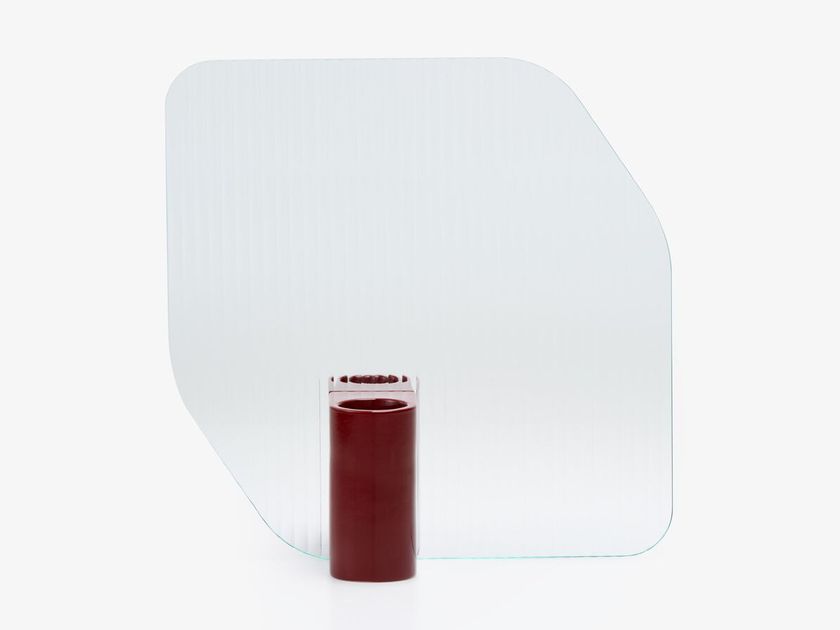
Alberti is a rectangular wall-mounted mirror.
"Alberti is a mirror conceived as a true architectural window: it does not merely reflect, but opens up space, inviting the gaze to go beyond its surface. This mirror plays with perspective. Its name pays homage to Leon Battista Alberti, a prominent figure of the Renaissance — painter, philosopher, and mathematician — and the first theorist of perspective in his treatise De Pictura. Alberti saw painting as an 'open window' to the world. Alberti continues this idea by transforming the reflective surface into a true architectural space.
The project originated from a study conducted during a visit to the Saint-Pierre Church in Firminy, designed by Le Corbusier and completed by his collaborator José Oubrerie.
In this building, the so-called 'canons of light' — geometric openings that pierce the mass of the building — sculpt space and transform light into architectural matter, creating formal paths for light. The building itself makes a transition from a square at the base to a circle at the top, generating an ascending geometric movement.
The shape of Alberti is therefore not a simple outline: it is a threshold. It represents a tension between inside and outside, a geometry that symbolically invites one to cross, to go to the other side of the mirror. Alberti embodies an almost philosophical idea: the mirror as space. Looking into Alberti does not simply mean seeing oneself reflected, but experiencing depth, perceiving multiple planes, multiple dimensions, multiple frames. It frames the reflection as architecture frames the sky, transforming the wall into a living and perceptible depth.
The Alberti mirror also recalls the design of the small Albers tables, published by Cinna. The connection goes beyond the similarity of names: it unites Leon Battista Alberti and Josef Albers, two figures separated by centuries but united by the same exploration of painting, perception, and geometry." Marie-Aurore Stiker-Métral
98
0