
Управление строительствомSTS#STS#Software#Geotechnics and foundations#Loadbearing wall calculations#Retaining wall calculations
STS
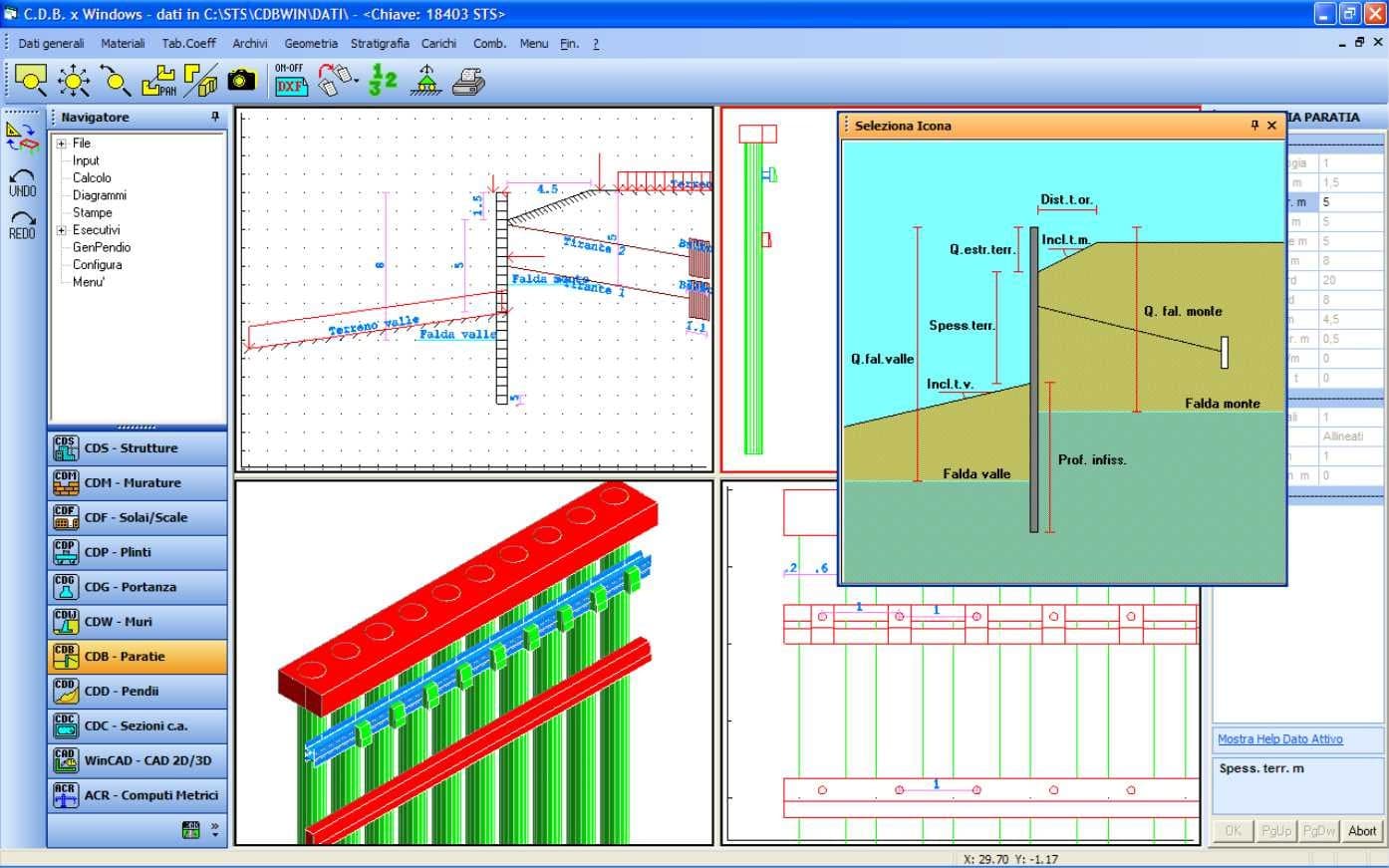
CDB Win is a programme specially designed by STS to deal with the calculation and verification of flexible bulkheads and diaphragms, including multi-timbered ones, in consistent and/or inconsistent soils. Various types of bulkheads are provided: rectangular-section baffles and r.c. piles, Berliners, metal profiles, Larssen, Hoesch, Union and with generic sections. The bulkhead can, however, be restrained and tensioned The anchorage of the tensioning rods can be assumed to be either dead-bulk or bulbous with in-service or breaking calculation.
For pile and berlin types, it is also possible to consider multiple aligned or quincunx rows.
It is also possible to lock translational and/or rotational degrees of freedom at the head of the bulkhead.
The stratigraphy of the soil can include up to 30 layers with different geotechnical characteristics, and it is possible to consider the presence of groundwater both downstream and upstream, and to study the possible filtration motion.
The embankment, the extrados of which can also have a broken bilateral profile, can be subjected to vertical actions, both distributed and concentrated, at varying distances from the bulkhead, the distribution of which is carried out according to the Boussinesq method.
Boussinesq. It is also possible to consider the presence of overloads on the ground downstream of the structure.
To supplement the loads acting on the embankment, further explicit actions acting directly on the diaphragm can be defined, even at several points.
For multi-tired bulkheads, in addition to being able to carry out the analysis for successive excavation phases and/or for different conditions of tensioning the tie-rods, it is also possible to consider the presence of the overload during the construction of the structure.
0
0