Управление строительствомAztec Informatica#Aztec Informatica#Software#Geotechnics and foundations#Slope stability tests#Construction
AZTEC FEM GT
AZTEC FEM GT is a software comprising a linear and non-linear FEM solver, a pre-processor and a post-processor dedicated to modelling the problem and using the results, respectively. AZTEC FEM GT can be used to simulate engineering problems of various kinds. Some examples of use are listed below:
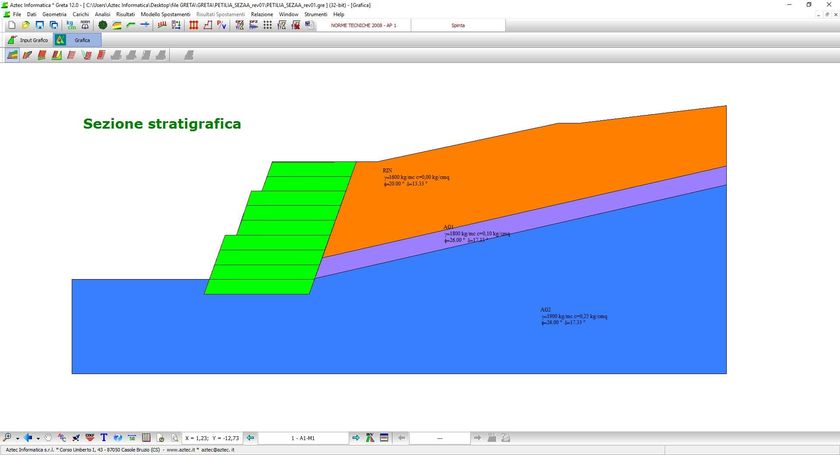
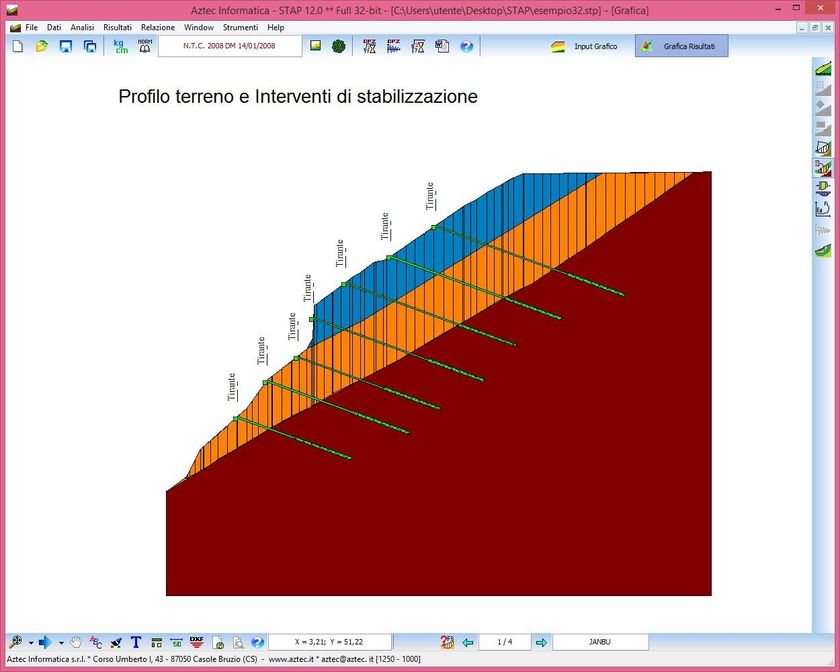
Slope stability analysis. In particular, it is possible to determine the safety factor of the slope itself, modelling the stabilisation works with their real resistance, and determining the interaction between them and the ground;
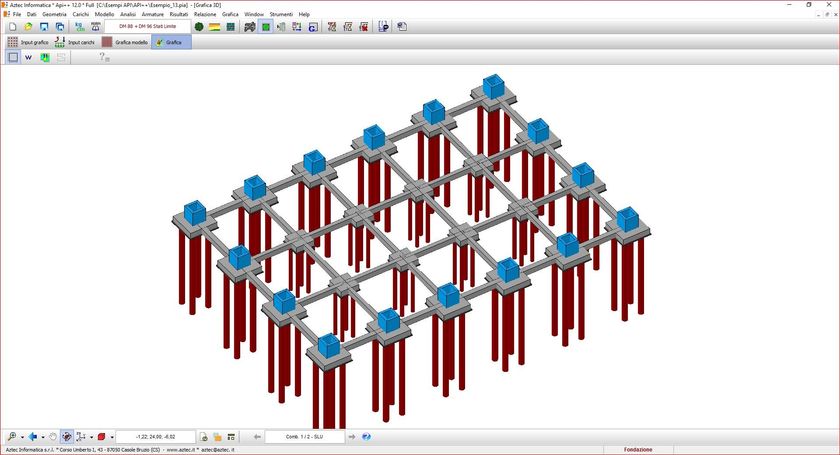
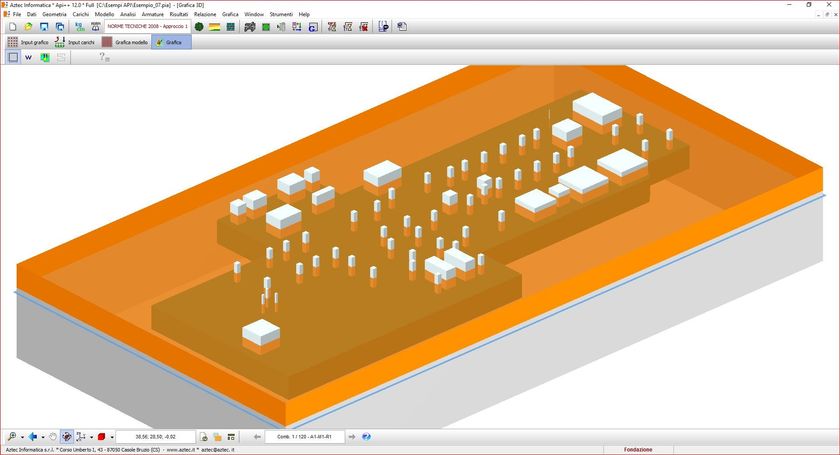
Determination of the limit load of surface and deep foundations;
Determination of the influence between the works built in the specified chronological phases;
Study of consolidation problems;
Study of filtration problems;
Study of problems in tunnel and tunnel construction;
Study of the behaviour of pressurised aquifers;
Dynamic problems.
Introduction
AZTEC FEM GT is a software package comprising a linear and non-linear FEM solver, a pre-processor and a post-processor dedicated respectively to modelling the problem and using the results.
Currently available in a 2D version, a 3D version will be developed later.
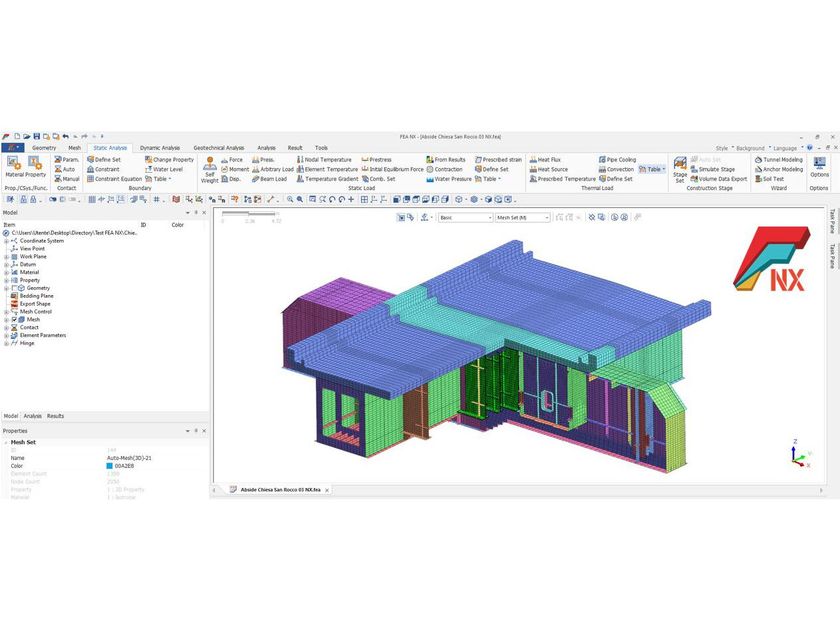
The pre-processor is a graphical-numerical tool that allows the problem to be modelled in its entirety. It guides the user in entering data by carrying out congruence checks. The User has the possibility of simulating the construction process of the works by extending the concept of phase to the chronology of the'temporal phases' of project realisation. The geometry input is free and allows the user to simulate multiple situations that may occur in reality. The modeller makes it possible to analyse problems involving
the realisation of excavations and landfills;
the insertion of retaining structures such as walls, bulkheads, reinforced soil.
It is also possible to simulate the construction of tunnels and galleries by considering the temporal phases involved in their realisation.
Finally, the modeller allows the simulation of
rigid or yielding point loads and constraints;
concentrated stiffnesses;
constraint lines;
load lines and surface loads.
Upstream of the analysis, the pre-processor performs the discretisation operation of the continuous model. This operation can be customised by the user through the setting of appropriate options that allow the selection of the mesh type and infills at predetermined points or in the vicinity of objects, e.g. in the vicinity of excavations or tunnels, etc.. The discretisation of the model, carried out in stages, is transferred to the solver that performs the analysis.
Fields of use
AZTEC FEM GT can be used to simulate engineering problems of various kinds. Some examples of use are listed below:
Slope stability analysis. In particular, it is possible to determine the safety factor of the slope itself, modelling the stabilisation works with their real resistance, and determining the interaction between them and the ground;
Determination of the limit load of surface and deep foundations;
Determination of theinfluence between the works constructed in the specified chronological phases;
Study of consolidation problems;
Study of filtration problems;
Study of problems relating to the construction of tunnels and galleries;
Study of the behaviour of pressurised aquifers;
Dynamic problems.
Types of analysis available
The FEM solver provides the following types of analysis:
Linear analysis;
Non-linear analysis by reduction of resistance parameters;
Non-linear analysis for load increments;
Non-linear analysis by increments of displacement;
Steady-state filtration motion;
Filtration motion transient regime;
Consolidation analysis;
Dynamic analysis.
Available Failure Crit
eria
The FEM solver implements internally, for materials with non-linear behaviour, several alternatives for the choice of failure criteria. The implemented failure criteria are listed below:
Von Mises;
Tresca;
Mohr-Coulomb;
Drucker-Prager;
Lade-Duncan;
Matsouka-Nakai;
Modified Cam-Clay.
Some of the above criteria have also been developed in the field of non-associated plasticity.
Library of Finite Elements available
The developed library of finite elements is very extensive, and includes elements that differ in form, range of use and number of nodes. In particular, the following elements have been developed for the analysis of two-dimensional problems (plane state of deformation or plane state of tension):
Triangular element with 3, 6, 15 nodes, respectively with linear, quadratic and fourth-order interpolation for displacements;
Quadrangular element with 4, 8, and 9 nodes, with interpolation, linear for displacements, for the four-node element and, quadratic for the 8- and 9-node elements.
Beam element with 2 or 3 nodes (three degrees of freedom per node, two displacements and one rotation);
Interface elements, to simulate the correct behaviour in the contact zones between the structural elements and the ground. The types of elements implemented are: springs with non-linear behaviour or alternatively Zero Thickness Element Interface elements with four or six nodes, respectively.
For the above-mentioned elements, variants have been implemented to account for water pressure.
Output
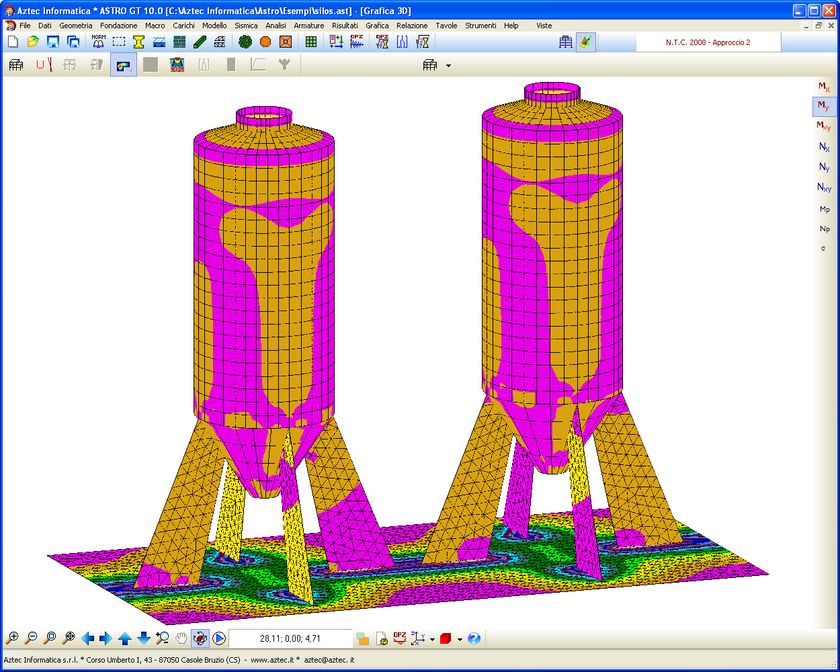
The post-processor is a tool designed for the graphical and numerical display of the results generated by the solver. Through this tool it is possible to visualise for each individual phase
the deformations;
the tension state for each tension component by means of a colour map representation;
the visualisation of the course of the yield function and the invariants of the stress tensor;
the stress state in structural elements.
All graphical views offered by the post-processor can be queried using the mouse.
The results can also be consulted in tabular numerical form. In addition, the post-processor provides the user with the possibility of direct printing or exporting drawings in DXF format or other graphic formats such as JPEG, GIF, TIFF, PNG, BMP, etc. The numerical results obtained can be exported in RTF and PDF formats, resulting in the calculation report. The calculation report can be customised by the user by choosing which forms to generate, the fonts to use and the images to insert. The pre- and post-processor graphic windows are equipped with the typical functions of CAD environments, such as single and multiple object selection functions, the automatic generation of certain objects, zoom and pan functions, the print preview function, the print preview function, the drawing layout function, i.e. the possibility of constructing tables containing several views, each of which can be represented with a user-selected scale factor, and much more.
AZTEC FEM GT stores data in a proprietary binary format and imports data from Aztec Informatica's other software packages.
Finally, AZTEC FEM GT supports XML format as a data interchange file and will be accompanied by an electronic manual (divided into user manual and theoretical manual) and context-sensitive online help.
0
0