Управление строительствомAztec Informatica#Aztec Informatica#Software#Geotechnics and foundations#Loadbearing wall calculations#Construction
Aztec Informatica MAX LT
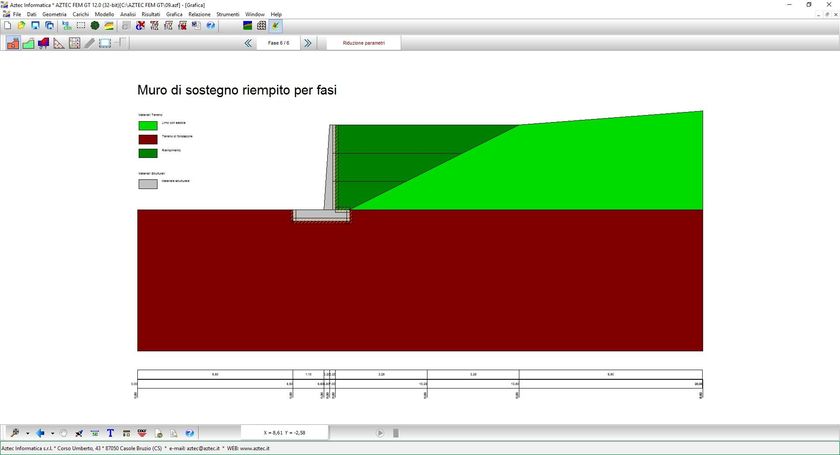
The MAX LT (Software Support Walls) programme allows the analysis and calculation of:
- Gravity retaining walls
- Semi-gravity retaining walls
- Cantilever retaining walls
- Step retaining walls
- Concrete or rubble retaining walls
- Retaining walls with spur or foundation tooth
- Retaining walls with head restraint to simulate cellar walls
USED CALCULATION
METHODSThe calculation methods implemented in MAX LT (Software Support Walls) are the following:
- Rankine, Coulomb, Culmann and Mononobe-Okabe: calculation of buoyancy in both static and seismic conditions
- Terzaghi, Meyerhof, Hansen,and Vesic: calculation of the bearing capacity of the surface foundation
- Fellenius or Bishop: analysis of stability in the vicinity of the work
- Admissible stresses or Limit state method
calculation of reinforcement and verification of sections
INPUT DATA-
Geometry of wall (and of the elements present)
-
Insertion of overloads (concentrated and/or distributed)
-
Insertion of loads on the wall
-
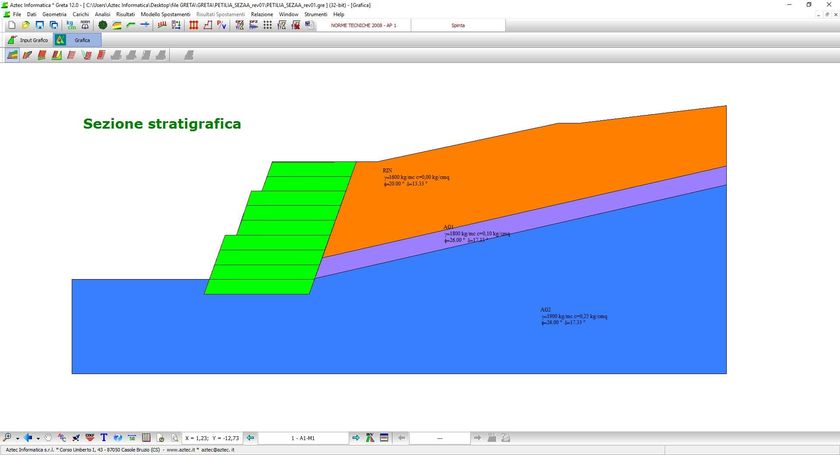
Definition of stratigraphy of the foundation soil and embankment
-
Definition of the height of the water table upstream and downstream of the wall
-
Reinforcement parameters (face reinforcement, foundation reinforcement)
OUTPUT RESULTS
MAX LT (Software Support Walls) allows all results to be displayed:
- Thrust wedges
- Pressure diagrams
- Stress diagrams (facing, foundation, brackets)
- Thrust diagrams on the wall and facing with associated breaking wedges
- Creep surface with minimum safety factor
- Reinforcement design
- M-N diagram of sections
- Analysis of the wall under static and seismic conditions
- Each displayed drawing can be printed out.
NORMATIVE
- NTC 2008 (Technical Standards for Construction) and additions
- D.M. 88 + D.M. 96
- NTC2018
- Circular 21 January 2019 n.7 C.S.LL.PP
50
0