Управление строительствомAztec Informatica#Aztec Informatica#Software#Geotechnics and foundations#Processing geotechnical, penetrometer tests#Construction
Aztec Informatica
The Aztec Utility programme is made up of a series of modules, independent of each other, which make it possible to solve a number of frequent problems in the geotechnical design phase.
Software
featuresSoil
Relation
Allows all the representative parameters of soils to be determined by means of the classic relationships that link the three different phases that make up a volume of soil: solid, liquid and gas. These relationships link properties in terms of weights and volumes (weight of the solid part, of the liquid part, porosity, void index, saturation, weight per unit volume, etc.). Different formulae are proposed for each parameter to be calculated, depending on the known quantities.
Thrust coefficients
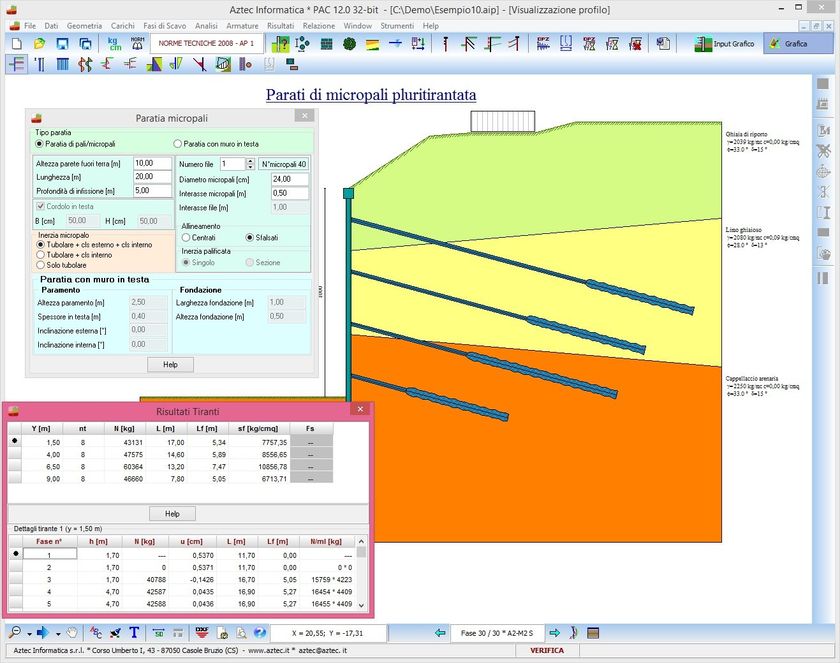
Proposes a method for estimating the order of magnitude of the thrust coefficient fs for the calculation of the tie, taking into account not only the geometric characteristics, but also the grout injection pressure when constructing the tie.
Soil thrust
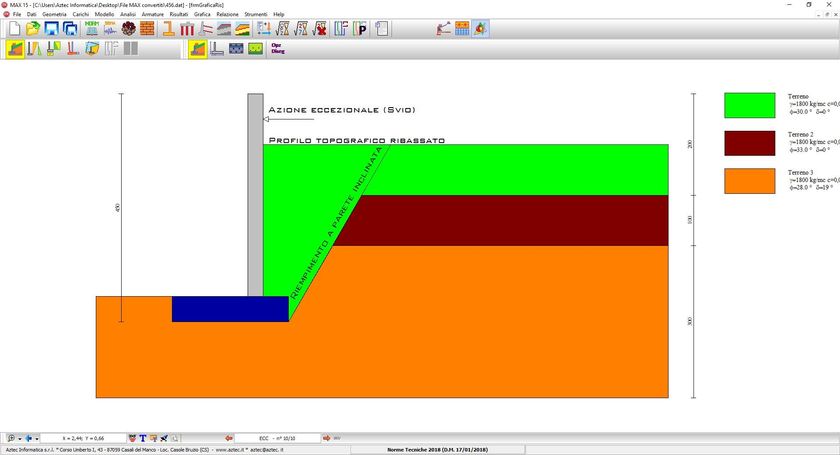
Allows the calculation of the active (Ka) and passive (Kp) thrust coefficients, as well as the associated thrusts, referred to a generic embankment using the Coulomb and Rankine methods.
Horizontal Winkler constant (foundation piles)
Allows the estimation of the horizontal Winkler constant for piles and micropiles in the presence of consistent (sands) and inconsistent (clays) soils with and without water table using the treatments of Davvisson (1970), Reese and Matlock (1956), Prakash (1963), Peck (1968), Bowles (1968) and others.
Winkler's vertical constant(rectangular foundations)
Allows the estimation of the Winkler's vertical constant for rectangular surface foundations subjected using the methodology of Joseph E. BOWLES, based on the bearing capacity (ultimate load) of the foundation calculated using the formulae of Terzaghi, Meyerhof, Hansen and Vesic.
Vertical tension
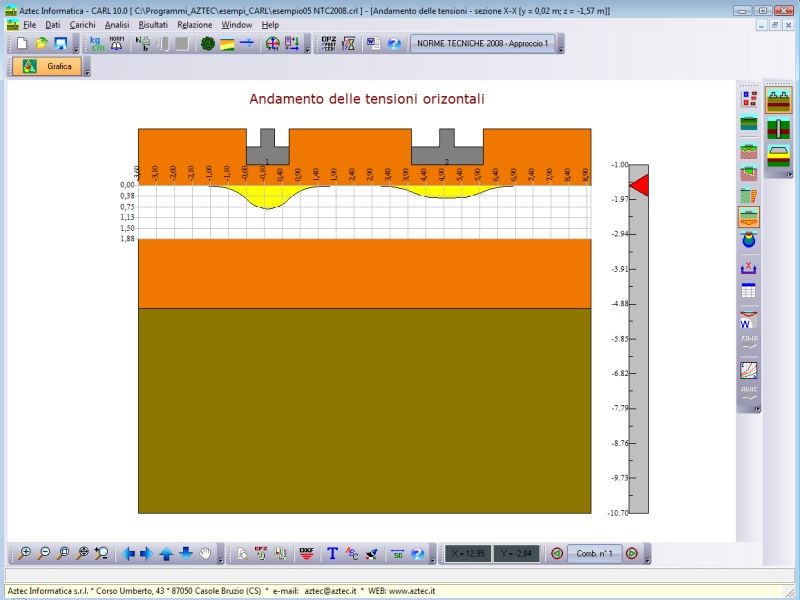
Allows the value of vertical tension to be determined at any point below the foundation, using the modified Boussinesq solution for distributed loads.
Geostatic pressure
Allows the total and effective geostatic pressure to be calculated at any depth in stratified soils with and without water table.
Water catchment tests
Allows estimation of the flow rate and/or filtration coefficient k in the case of water catchment tests in confined and unconfined aquifers.
Soil permeability
Allows estimation of the value of the total filtration coefficient (vertical and horizontal) for a stratified soil.
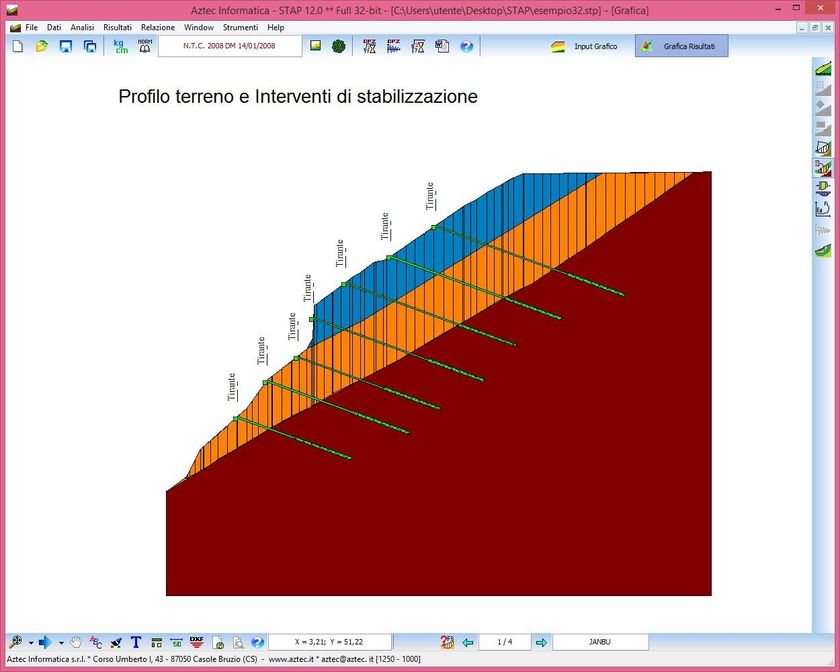
Tie rods
Allows the estimation of the thrust coefficient fs and the limiting pull-off for tie rods in all soil types using the Bustamante and Doix method.
Unit conversions
Allows unit conversions for forces, pressures, weights, lengths, areas, volumes and angles.
Mohr-Coulomb parameters rocks (c, ø)
Calculates the instantaneous cohesion and angle of friction referred to a value of normal tension, i.e. the values of c and f at the point of tangency on the curvilinear Hoek-Brown envelope corresponding to the acting sigma value. These parameters allow the use of the Mohr-Coulomb linear rupture envelope in geotechnical limit equilibrium problems.
Accelerogram Compatible Spectrum
Generates accelerograms compatible with assigned response spectra called "targets" through manipulations in the frequency domain. The programme automatically calculates the design response spectrum for the Ultimate Limit State (SLU), the Damage Limit State (SLD) and the elastic spectrum according to OPCM 3274. These response spectra can be displayed in the acceleration, velocity and displacement components.
Subsoil Classification (Type A-B-C-D-S1)
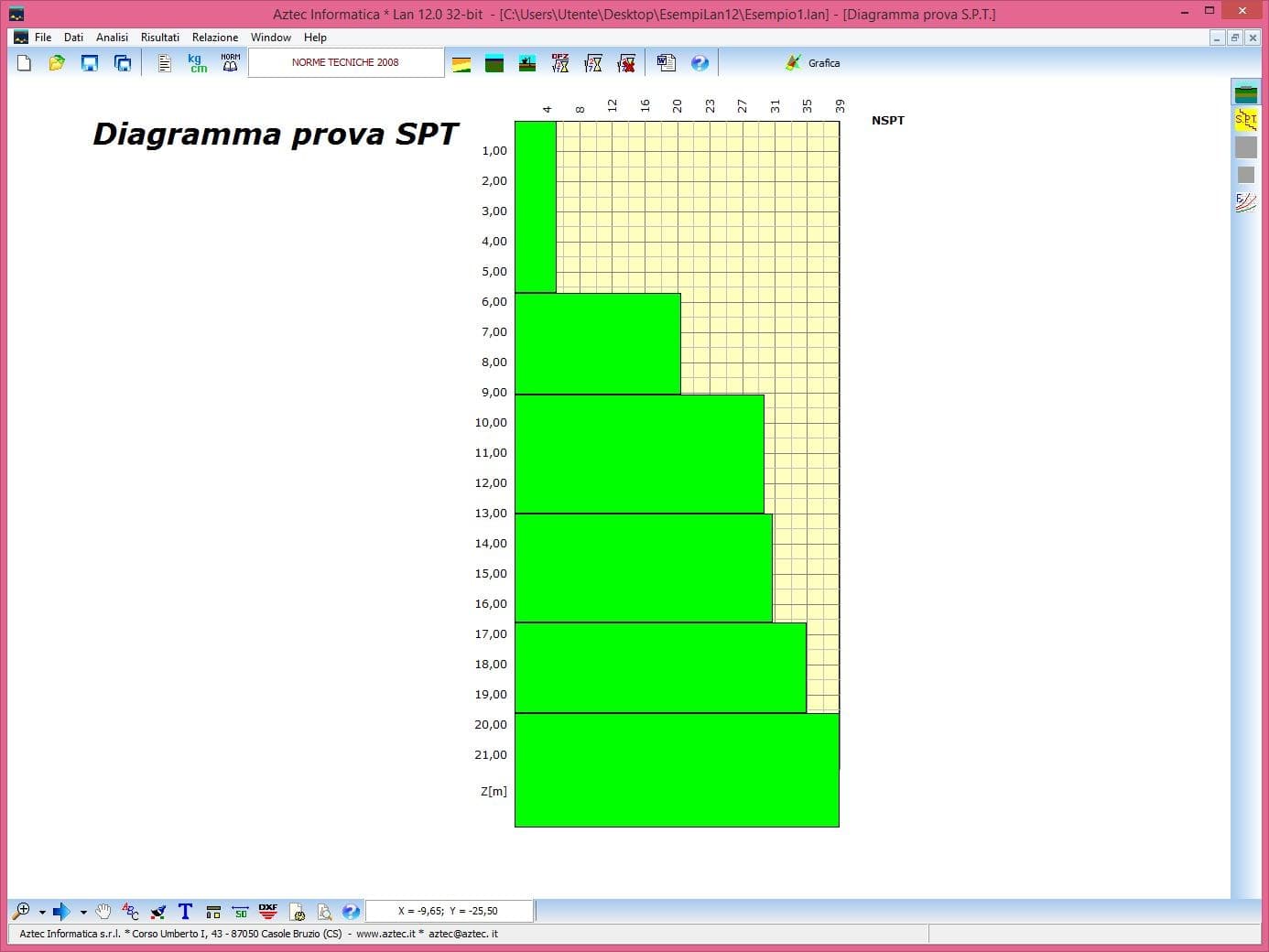
Allows the determination of the subsoil category from in-situ investigations in accordance with O.P.C.M. no. 3274 and subsequent amendments and supplements. It also proposes the adoption of a system of geophysical and geotechnical characterisation of the stratigraphic profile of the soil, using five types of soils (A - B - C - D - E plus two other special ones: S1 and S2), to be identified in relation to the shear wave velocity parameters on the first 30 metres of soil (VS30). The programme provides correlations between shear wave velocity (VS), number of S.P.T. test blows (NSPT) and compression wave velocity (VP).
Pile limit load (load tests)
It is developed for the determination of the vertical limit load of a pile based on static design load tests on pilot piles. The limit load is evaluated using the hyperbola method and the exponential curve method. These two techniques allow the results of the pile load test to be interpreted and consist of interpolating the load-deflection curve with an analytical expression that best approximates the curve.
Area and inertia polygons
Allows the area (A), centre of gravity (xG, yG) and moments of inertia (Ix, Iy, Ixy) of a generic section defined by polygon to be determined. The section may possibly be pluriconnexed.
Centre of gravity and resultant of a system of concentrated forces (masses)
Lets you calculate the total force (Ftot), centre of gravity (xG, yG), static moments (Mx, My), moments of inertia (Ix, Iy, Ixy) and polar moment of inertia (Ip) of any system of forces (masses) with respect to an absolute and relative reference system using Cartesian or polar coordinates.
Krey's formula
Allows a load diagram to be calculated to directly take into account concentrated and/or distributed loads applied at a certain distance from a diaphragm on the upstream soil profile.
0
0