Управление строительствомAztec Informatica#Aztec Informatica#Software#Geotechnics and foundations#Slope stability tests#Construction
Aztec Informatica
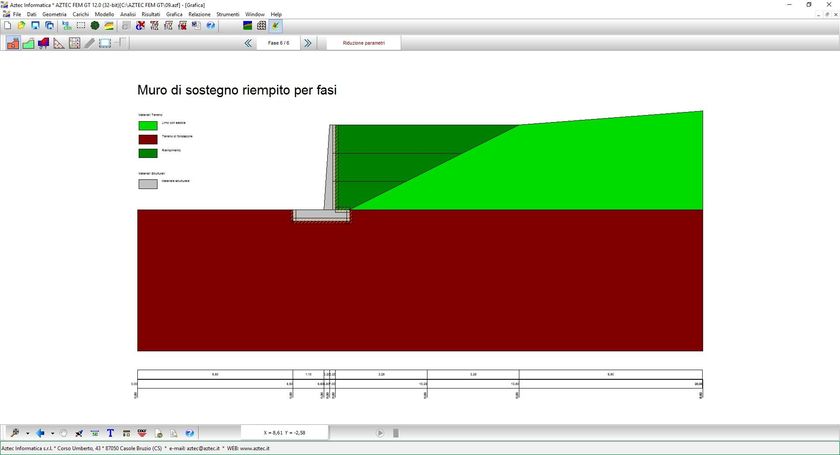
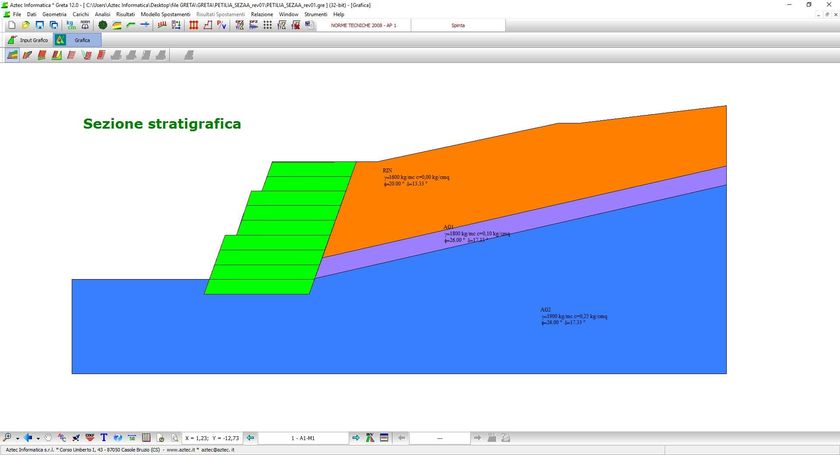
The STAP - Soil and rock slope stability software enables the stability analysis of slopes in loose soils and rocks. The analysis can be conducted under static or earthquake conditions in both horizontal and vertical directions.
STAP FULL also generates the Technical Report in English.
DETAILS
Standards
NTC 2018
Circular 21 January 2019 n.7 C.S.LL.PP.
NTC 2008 (Technical Standards for Construction) and its integrations
D.M. 88 + D.M. 96
Calculation methods
The calculation methods implemented in STAP are:
Fellenius
BishopJanbu simplified
Full Janbu
Bell
Morgenstern-Price
Spencer
Sarma
Maksimovic
GLE (General Equilibrium Method)
For all methods, it is possible to perform the stability analysis under static conditions or in the presence of an earthquake. In the latter case, the applicable methods are the pseudostatic method and the dynamic method (dynamic analysis using the Newmark method).
Input data
Definition of the extension of the slope
Definition and characterisation of the stratigraphy
Definition and characterisation of the stratigraphy
Definition of the fracture surface(s) (circular, logarithmic and generic spiral)
Input of the loads on the topographic profile
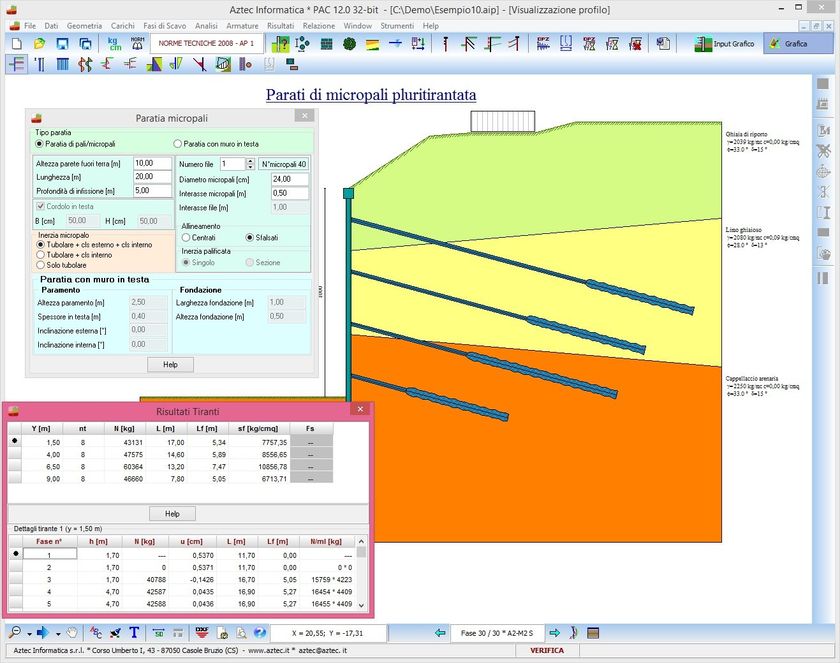
Input and characterisation of the stabilisation measures (retaining walls, bulkheads, tie rods, steps and reinforced soil)
Uniaxial compressive strength of rock
Intact rock material coefficient
Rock mass quality GSI
Roughness coefficient JRC
Joint strength coefficient JCS
Base friction angle
Results
When the analysis is complete, STAP allows all results to be displayed:
Number of surfaces analysed
Coefficient of safety for all surfaces analysed
Maximum and minimum value of the safety coefficient and sliding surfaces to which they refer
For each surface analysed: factor of safety, volume of the sliding surface and points of intersection with the slope; if the surface is affected by stabilisation work, the programme displays the coefficient of safety of all "sub-surface areas" identified by the work.
For each selected strip, it is possible to obtain information on: geometric characteristics regarding mass, cohesion and angle of friction, force on the strip, inter-strip forces:
Variation of the safety coefficient as a function of the force applied downstream of the surface
Variation of the safety coefficient as a function of the groundwater level
Variation of the safety coefficient as the ground parameters vary
Variation of the safety coefficient as the resistance and position of a generic intervention vary.
0
0