Управление строительствомCDM Dolmen#CDM Dolmen#Software#Structural calculations#Structural calculations for pre-compressed reinforced concrete#Construction
CDM Dolmen
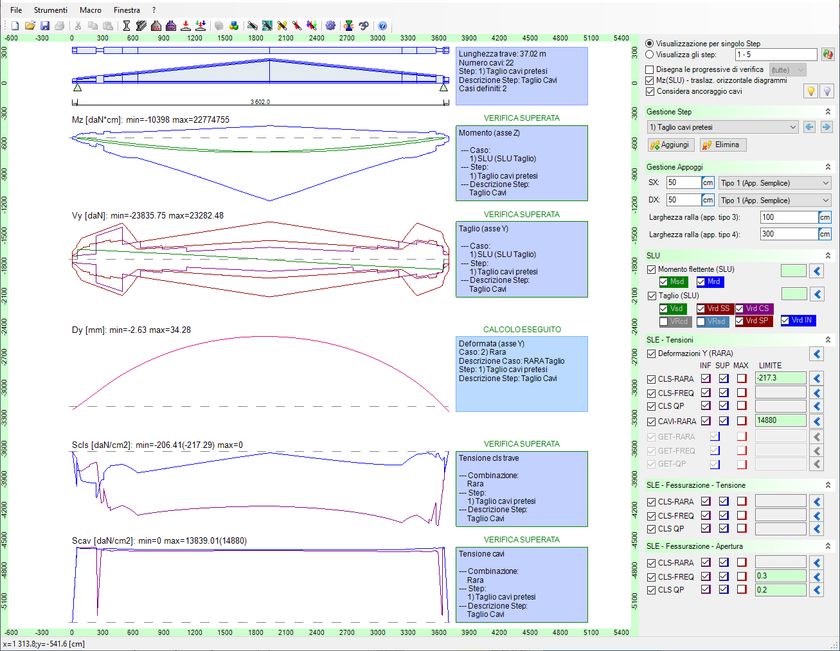
ISTraveCAP issoftware for the design and verification of prestressed concrete beams with adherent cables with partial or total prestressing and possible in-situ casting. The limit state calculation considers all the executive phases.
The beam under study can have sections of any shape, even imported from dxf files, symmetrical or non-symmetrical development, a flat or sloping soffit and extrados.
Along the development of the beam, the slow reinforcement and prestressing reinforcement can be defined (also imported from dxf files), specifying the number of adhering cables, which can be constant or variable.
The management of the execution phases, conditions and load cases is fully automatic, leaving the possibility of user intervention. The calculation of tension loss due to relaxation and shrinkage is also performed automatically by the software.
The programme is able to consider all the different life phases of the beam with the relevant material characteristics. For each phase, all the verifications required according to the most recent standards are carried out, both at the ultimate limit state and at the service limit states. The verifications may be carried out in simple bending or in deflection.
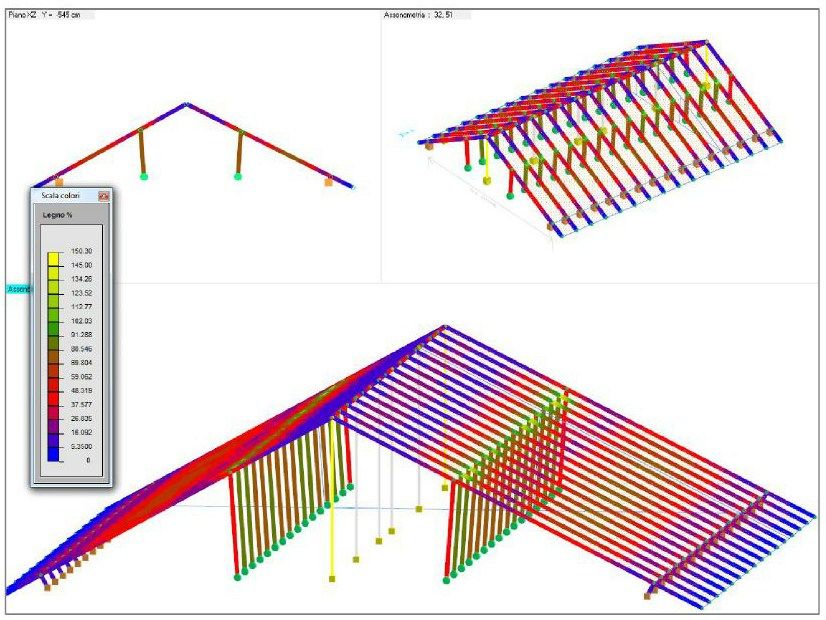
It is possible to view the beam created in 3 dimensions with a transparency effect in order to see the bars and cables present.
CHARACTERISTICS
The beam under study can have sections of any shape, taken from a large database of standard sections (T, double T, L, purlins, roof tiles, etc.), or defined by points or imported from a dxf file; similarly, from .dxf it is possible to introduce the irons, cables and holes that may be present. The beam may have a non-symmetrical development, a flat or sloping soffit and extrados with sections and heights that vary along the axis with continuity or in a punctual manner.
Along the development of the beam, slow reinforcement and prestressing can be defined, specifying the number of adhering cables, which may be constant or variable (condition realised with the insertion of insulating sheaths). Transversally, the cables are inserted into the section by defining their horizontal and level coordinates, which allows the case of deviated bending to be correctly calculated.
The insertion of sections and irons is made easy by 'select and drag', 'copy', 'mirror' functions, as in a professional CAD.
The self-weight of the beam and any supplementary casting are automatically calculated.
The management of the execution phases, conditions and load cases is fully automatic, leaving the possibility of user intervention. The calculation of tension loss due to relaxation and shrinkage is also performed automatically by the software.
The programme is able to take into account all the different phases of the beam's 'life' with the relative characteristics of the materials: the moment the cables are cut, handling and storage in the factory, transport to destination on tractor-trailers with fifth wheel couplings, installation, any completion castings and operating conditions. Beams can be designed in which the position of the supports in the final situation results in the creation of considerable overhangs. For each phase, all the verifications required by the standard are carried out, both at the ultimate limit state and at the service limit states. The verifications may be conducted in simple bending or in deflected bending.
It is possible to view the beam created in 3 dimensions with a transparency effect to see the bars present.
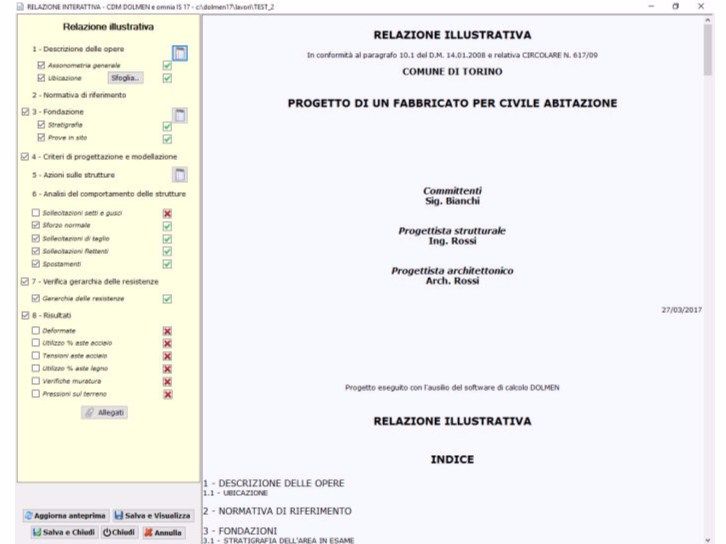
IS TRAVECAP creates a complete and detailed calculation report in HTML (.html), Word® (.doc) or text (.txt) format. Each graph and the report can be printed on a Windows-managed device. Use of the programme is intuitive, each command can be accessed via the Main Menu or from the icons on the toolbar or by right-clicking.
0
0